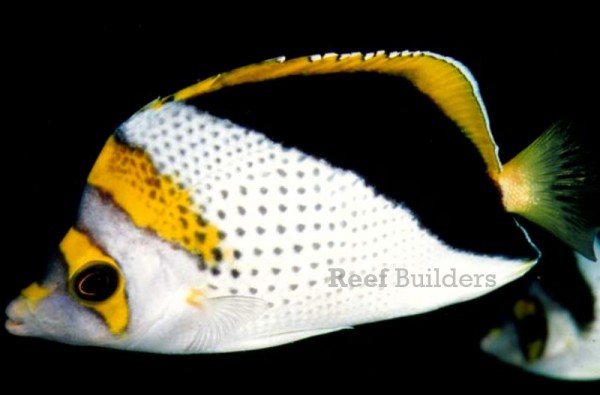

Not sure what is in the air lately but have we got the goods on a nice handful of uber rare butterflyfish fish for you. Hot on the heels of the orange margin butterflyfish, Prognathodes basabei, we have an odd-phase gold crown butterflyfish, Chaetodon (Roaps) flavocoronatus, a new version of a presumed Tinker hybrid and for the first time ever for the aquarium trade, the extremely deep dwelling Roa excelsa. Starting with the Gold Crown Butterflyfish in the image above, it was collected in Tarawa, an atoll in what used to be the Gilbert & Ellice Islands but is now considered Kiribas (Kiribati) at a depth of 300 ft. This fish was caught well outside of the population center for Chaetodon flavocoronatus (Guam) and the dark markings in the crown of the five specimens that were caught leads us to believe that these fish have some history of crossbreeding with other members of the Roaps subgenus; a little C. burgessi here, a little C. tinkeri there. IN either case, these stunning specimens are spectacular and for the price, they might as well have been full blooded Gold Crown Butterflyfish. Follow the break to read more about the Roaps tinkeri hybrid and the Roa excelsa.

This unusual Chaetodon tinkeri was caught in the Hawaiian islands at a depth of about 170ft, and we believe it was caught paired up with another Tinker because it was offered as part of a pair. Other than than the fact that only one of these was caught, we have few other details on this fish. This fish might also have some crossbreeding with other Roaps but other than the dark eye-stripe (which is normally bright yellow, bordered in black), this fish show few other characteristics of other species and it is a lot more attractive than dirty burgess butterflyfish which is in less demand in the aquarium trade.

Last but certainly not least, the Hawaiian Gold Banded butterflyfish, Roa excelsa are the rarest and deepest dwelling fish which were recently brought up alive for the aquarium trade. These two fish wee caught by expert fish collectors Rufus Kimura and Jessie Wilson. Both of these divers deserve a golf clap for their rebreather dives down to over 450 feet to collect and the 8 hours of decompression which was necessary to bring these fish from such depths in good condition. You can bet that the effort it took to collect these fish will be reflected in the price of these fish which should be landing at Blue Harbor in Japan anyday now.