Reef Builders - The Source for Reef Keeping Information

Reef Builders Sponsors


Archive for the 'Saltwater Fish' Category

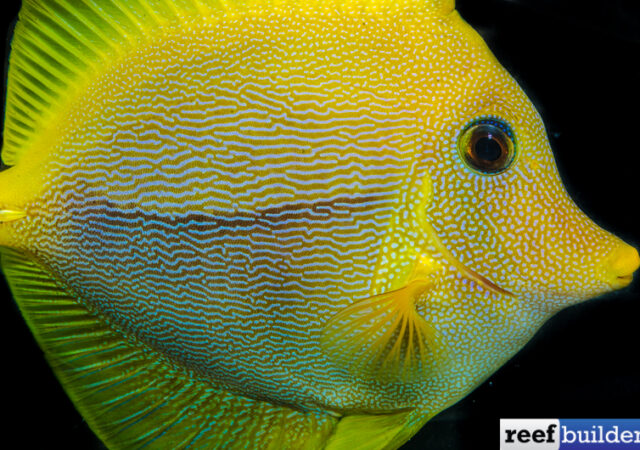
Indian Ocean sailfin tang, Zebrasoma desjardinii

Posted June 28th, 2007 by Ryan

Salifin Tang

This species comes from the Red Sea and Indian Ocean; along with its close relative Zebrasoma veliferum from the Pacific, it is the largest Zebrasoma tang, potentially growing to 40 cm/16″. If you want to keep one you need a large aquarium. When I decided to set up a large tank, this species was high on my list of intended fish. It is slightly less frequently seen, at least in my local dealers, than most of the popular tangs so I had to wait a while to get one.

(more…)

sohal tang

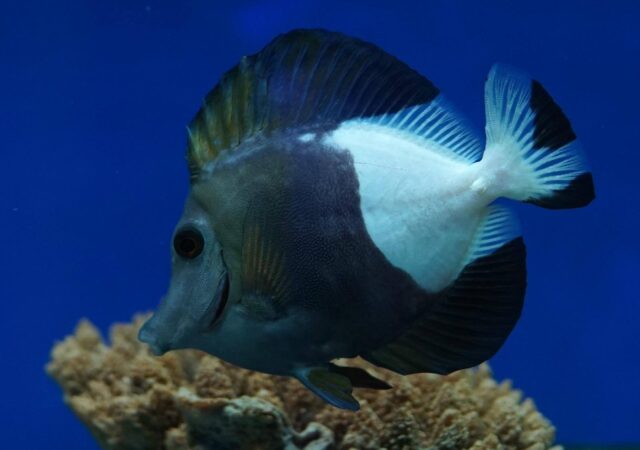
The Sohal Tang or Red Sea Clown Tang is from the Red Sea and the Western Indian ocean. Although fish from the Red Sea are generally more expensive, they are always net caught and are handled with more care, which gives them a much better survival rate. These fish are somewhat difficult to keep, but you should be able to obtain a very healthy specimen which increases the chances of this fish surviving in the aquarium. The salinity should be kept near 1.025 and constant; pH should be buffered between 8.2 and 8.4., and temperature in the mid seventies to low eighties degrees Fahrenheit. These guys need constant feeding of algae (nori) in small amounts. These tangs are great for the more advanced aquarist.

Clownfish pair

If you love tropical fish, then finding quality livestock for your aquarium is important. Most pet stores buy their fish from wholesalers, who get their fish and other animals from fish farms around the world. The world of a wholesale fish dealer is fascinating, and in very large scale.

(more…)

Anthias for your saltwater aquarium

Posted June 1st, 2007 by Ryan

Many people think of members of the grouper family as a tasty main course, rather than a brilliant adornment to the coral reef community. However, reef crests throughout the Pacific to the Indian Oceans and even the Red Sea, are graced with a myriad of small brilliantly colored little fishes of this family (Serranidae), known to reef hobbyist as Fairy Basslets or Anthias.

redfinAnthias are smallish fish by general standards, most reaching only 4 to 6 inches in length at maturity. They all display brilliant colors: red, pink, orange, yellow and some even lovely purples. Their size makes them ideally suited for reefs, especially since they feed mostly on plankton and do not display any aggressive behavior towards any other reef inhabitant.

These colors are part of their territorial display features, and actually may aid in camouflage as the light fades and with it, the colors of the reef. They have lunate (half-moon shaped) tails and fusiform (bullet shaped) bodies which allow bursts of sudden speed when need for feeding or defense. Most of the time they are slow swimmers and may not even move much for great lengths of time, except when aggressed or when a sudden supply of food becomes availabe and they need to swim to reach it.

All anthias have, in varying distinctiveness, a bar that runs from the eye to the pectoral fin (tail fin). These fins are broad and soft, perfect for maneuvering through their coral homes. Overall the fishes shape is very characteristic and makes Anthias easy to differentiate from other fishes. Their mouths are large and in one genus Mirolabrichthys, the snout is very pronounced.

Anthias live in large colonies around branching and table corals (Family Acroporidae) among which they find shelter and a place to rest at night. They are generally diurnally active (meaning they are active during the daylight hours), and spend a great deal of time hovering above their chosen coral head, scooping up their plankton diet. The forereef and reef crest are rich in drifting plankton, and the currents bring the food right to the waiting fishes. On any given reef, Anthias colonies may be made up of thousands of specimens.

Colonies are made up of smaller groups which are structured like a harem with an approximate ratio of one male to anywhere from five to twenty females.

They are sequential, protogynous hermaphrodites, meaning they can change from sex to another - from male to female. They hatch as females, which are gently colored in pink and orange colors.

After about a year, some of the females will change to males. Out of that group of bachelor males some will become “supermales”. It is not possible to predict how many female will change to males. The fact remains though that some do.

These changes take only a matter of weeks as color and behavioral patterns change. The ovaries degenerate and give way to the appearance of testes. Male coloration is generally much more brilliant than that of the females. Male colors go from vivid reds to oranges to purples, or any patchwork combination of the above which is exactly what makes these fishes so colorful. The dorsal fin develops into an elongate filament, and the eye-to-pectoral fin bar intensifies in color.

Supermales defend their territories and their harem from neighboring supermales, while bachelor males hover around below the supermales and females. The juveniles remain towards the center of the colony. This behavior is typical of harems that are not yet ready to move to the spawning phase as, when that happens, behavior changes completely as we shall see.

Aquarama’s most expensive fish?

Posted May 30th, 2007 by Ryan

platinum1.jpg

One of the most photographed fish at Aquarama 2007 is also one of the show’s most expensive - a platinum arowana with a mortgage-inducing price tag.

The fish is an Osteoglossum species from South America, rather than the usual Scleropages from Asia, and is owned by Singapore-based Dragon fish breeder Aro Dynasty.
Unlike most Osteoglossum, this mutant is virtually white with virtually no other colours present, not even on the dorsal surface.
It was recently offered for sale to prospective buyers by a UK arowana importer for more than £200,000.
However, Aro Dynasty told Practical Fishkeeping Online that the fish is no longer on the market.
It confirmed that it turned down S$80,000/£26,376 for the fish a few years ago.

Read

Corals, Livestock, finally here!

Posted January 12th, 2007 by Ryan

liveaquaria.jpg

Finally it’s here. Thanks to the speedy delivery of Priority Overnight by Fedex. These boxes just arrived. What do they contain? Find out soon! For now, all you get to see is a teaser box. Can anyone of you guess? Post in comments!

Clownfish & Blue Tang Quick Pictures

Posted January 8th, 2007 by Ryan

clown21.jpg

clown.jpg

blue_tang.jpg

Here’s a few quick pics I took the other day. Thought I would share with you all. The Blug Tang is growing really fast! I hope he is okay in this 75 Gallon Aquarium.

Puffer Fish That is very Friendly

Posted December 20th, 2006 by Ryan

pufferfish.jpg

I saw this guy at the local PETCO. Which is probably one of the only places to buy saltwater fish where I live. Anyways, I thought he was very friendly. And I snapped this shot of him. I think he is saying: “take me home”.

Roger the Achilles Tang gets a new Home

Posted November 5th, 2006 by Ryan

clif_wroger.jpg

So over the weekend I decided to give Roger up for sale since I thought he was a little to big for my tank. I posted him for sale and Cliff out of Irving, Texas decided that he just had to have him. He said that he was looking for an achilles tang like the one I had for a very long time. Anyways, this Saturday I handed over Roger to Cliff. I hope Roger will be happier. I know Cliff is.

Roger — The picky eater

Posted November 2nd, 2006 by Ryan

achilles.jpg

I recently wanted an Achilles Tang for my aquarium. Of course knowing how big tangs get I wouldn’t get to keep him in my tank for the life of him. So I figured I could order a small one and raise him in my tank. He arrived yesterday via UPS Next Day Air, which surprisingly came around 10:00am. So I opened the box and VIOLA! To my amazing he was beautiful, however he was much to big for my tank in my opinion, he needed a lot of space to swim around in. So if any of you out there would be interested in acquiring a tang feel free to contact me at info [at] reefbuilders.com Oh his name is roger and he is a very picky eater.


Close
E-mail It