

This thing was constructed on September 3, 2008, and it was categorized as Reef Articles.
You can follow comments through the RSS 2.0 feed. You can leave a comment, or trackback.

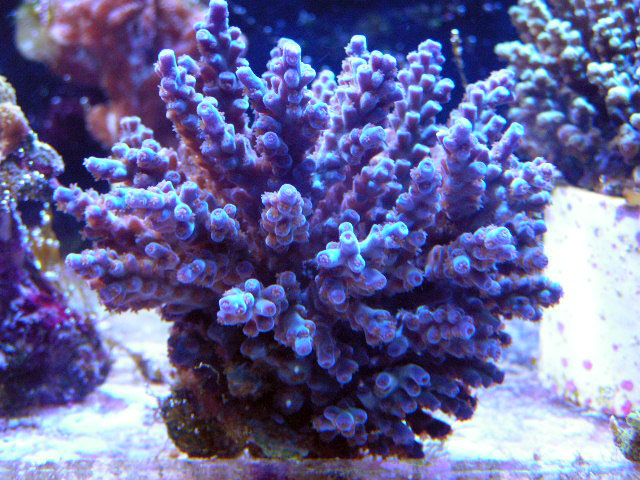
This guide endeavors to assist you with the ever popular SPS coral. This was  written by member Shadowramy and it explains specific ideas and strategies in which you can do to affect the color of your corals. This assumes you have a more then basic understanding of water parameters in your tank. Click the read link to start reading about coloring in SPS corals.

In the past I have been asked a lot about coral colorization as well as wanted to satisfy my own curiosity about specific methods to achieving certain colors. Usually I am asked, “How do you get good colors?” Which I then ask, “What specific color are you looking to enhance?” Over the past several months I have really worked on “tweaking” colors and what is needed to get certain colors. I have done my own testing as well as seen a lot of others tanks and what they have done to achieve certain colors. I think I finally have a basic map for those who are interested.

Please note: I am assuming that you meet the minimum suggested standards to keeping SPS; strong lighting, calcium at the appropriate levels, strong skimming and live rock.

Yellows

Highly dependent on Nitrate and PO4 levels. Of course all SPS colors are highly dependent on lack of N and P so I wanted to start with probably the easiest color to get, yellow. Yellows are sort of you baseline; yellows will tell you a lot about what is going on in your tank, what is needed and what is overdosed. Nitrate and/or PO4 reduction is most important, either through technical means such as nitrate/phosphate reducers or biologically through DSB, Carbon dosing and/or water changes and fuges. Basically, if you want to do SPS, I would suggest starting with an acropora that is yellow. If you can get it to say yellow for several months, you should be ready for something else.


Greens

Greens would be the next easiest color to tweak. Most green coloration can be achieved through the addition of an Iron Concentrate (Kents is what I use, however Iron is Iron). You must be very careful with Iron because it is also an Algae accelerator; this is why it is so important for you to get your yellows colors first (your N and P will be lowered).

Additionally, I use my yellows as indicators for my greens and blues. You’ll notice a deficiancy if your greens are brown color or they are paling in color. I start off by dosing Iron at about 1 drop per 50 usg twice a week and take note of what happens, color changes, Algae growth, until my yellow acroporas display a green shimmer (it wont be a solid green but a shimmer of a green/yellow).

Please note, a sign of overdosing is a darkening of tissue, when this happens you have added too much iron or too much iron is being added. Another sign of overdosing is Algae growth, stop immediately and possibly do a water change if necessary. Like everything else reef, go slowly.


Blues and some purples

This is mainly for blues but I have found is can also have an effect on purples. The supplement for this is Potassium Iodide Concentrate or Lugol’s solution, ESV Potassium Iodide Concentrate will also work; don’t just get something that says Potassium because that is a little different. Dosing should be done when blue colors become less intense. Again, using yellow corals as indicators, stop dosing when yellow corals display a green shimmer.


Reds/Pinks and some Purples

Primarily for coloring reds and pinks in Montiporas, Pocilloporas, Birdsnest, other Stys and Seriatoporas. The supplement is Potassium (not potassium iodide). If you are using a high potassium salt mix such as Oceanic, Tropical Marine Pro and you are doing regular water changes, you are more than likely not going to need to supplement this much.

For dosing you can use your monitporas, especially caps as indicators. Supplementing is required when Montiporas display slower growth and appear washed out to grey appearance. Indicators on Stys and Pocs are when they look like they have been exposed to air. Polyps are completely withdrawn and colors are light. Other indicators of potassium deficiency is when the pinks turn into a light brown and when acroporas loose their color and get lighter and pale. A major potassium deficiency is seen when tissue is lost, mostly starting from the base opposed to spotting (patchy look). And overdose can lead to tip burning so don’t mistake tip burn for new growth. Tips burns will be white with no polyps.


Purples

Probably one of the hardest coloration of all acroporas from my experience since it is a combination of several variables.

First and foremost is water clarity, which means Carbon and/or filter socks. I have also had good result from biological filters such as using cryptic zones, which produce seasquirts, sponges and other filter feeding animals. Zeo Sponge Power, which can be used in any system, feeds sponges. Sponges are great because they can filter a mass amount of water for better water clarity.

From what I have noted, increased water clarify will first effect SPS tips but not the complete base. I have seen nana and valida with really nice purple tips but brown/tan/white bases. I have seen the same nana and valida in another’s tanks, which met all other parameters with a full purple from base to tip.

Second being lighting. From my observations of my own tank and others, purples seem to love 420-440nm range light spectrum, those found in actinics and 20K halides. Some of the best purples I have seen are in tanks that have 440nm blue actinics (ATI Blue+, Giessman Actinic) or 20K Halides (Radium, XM 20K).

Third, supplements such as Iodide and Potassium (see blues and Reds/Pinks). Again, make sure your greens are green and yellows are yellow. Your blue should be bright with depth. Iodide will also help if you have tip burn.

These are just my observations through testing and I am sure in the future other factors will be seen and added. Please feel free to comment with your own observations, data is very important to moving forward.


Author: Shadowramy

Other items you might enjoy:

This post was written by .


search more:

This thing has 6 Comments

  1. mini69
    Posted September 4, 2008 at 1:23 am | Permalink

    thanks for the post it being informative

  2. Mike
    Posted September 19, 2008 at 9:27 am | Permalink

    This article is informative, but I think you should give credit, that this is not your writing or analysis.

    This was originally posted in an RC post, and was also previously posted here: http://www.reefbuilders.com/2008/09/03/guide-of-sps-coral-coloration-make-them-more-vivid-bright/

    Send those with questions to the actual authors.

  3. Mike
    Posted September 19, 2008 at 9:27 am | Permalink

    Sorry, meant to say originally posted here, a day before you posted: http://www.reef-mania.com/

  4. Posted September 19, 2008 at 5:35 pm | Permalink

    Mike, thanks for the comment, I had already given credit to the author: Shadowramy

  5. WreckDiver
    Posted August 1, 2009 at 11:19 am | Permalink

    I think most of that article is, as Penn and Teller put it, BS. First off you should not dose Iron to a reef tank unless you have a huge load of Macro Algae or want to grow algae in your reef, Second, Potassium dosing is EXTREMELY dangerous. I got into a discussion on that several months ago in a reef Chemistry forum and was strongly advised by many people (biochemists), that is was a bad thing to do. There are not ANY accurate test kits for potassium and 1ml too much can toast your tank. The rest was common knowledge in the hobby, reduce NO3 and PO4 for good colors.
    What the article neglected to mention is that Reds, Pinks, Yellows like a lower K bulb as well. You will be hard pressed to find a neon pink Stylo or Poci in a tank lit with 20K bulbs unless it is highly supplemented with 10K T5’s or VHO’s. Pinks, Yellows and Reds like a range between 10K and 15K for best coloration, and that is due to the wavelengths that have those colors in them.
    Not to get way overboard with physics, but the colors we see are actually colors that are reflected by an object while it absorbs the other colors in the light spectrum. So, to have bright reds, pinks and yellows you will need a light source that has a fair amount of light in the 3000K – 8000K range. Most 20K bulbs have very little light energy in those spectrum ranges, whereas, the closer you get to to a 10K bulb there is more available light within those ranges.

    Most of the time you will here things like the natural sunlight is at 6500K. While that may be true, water is an excellent filter of light. As light enters and passes through the first 15 feet of water, the red and orange wavelengths are absorbed by the water, increasing the light’s K rating, and giving the light a bluer appearance. As the light penetrates to 30 feet, the water absorbs the yellow spectrum. And as the light continues past 50 feet, the water filters the green wavelengths, leaving just the blue and violet wavelengths. This results in light with the highest Kelvin rating. This is precisely why the most colorful corals on a reef when diving, are within the first 30ft of a reef wall. When you get down to 200-300ft (deepest I have first hand experience with is 280ft), there is very little light.

    So in our aquariums, we can use different light spectrum’s to pull out different colors and achieve different growth rates, depending on our own aesthetics and how we perceive our individual tanks. That is another reason why it is hard to advise someone on bulb colors temps. While I may like a blue tank with 20K and actinics, someone else likes the crisp white of the 12-15K range, and still others like the white look of a good 10K. It is always an individual decision in the end.
    The one thing the article did state that is a fact, is the water quality factor. If your NO3 is above 10ppm, you probably will not have good colors. Excellent water quality, stable parameters (380-450 Ca, 8-12 DkH, 8.1-8.4 PH, 1300-1500 Mg, 1.0245 – 1.0265 SG), and a good lighting setup are the three main components to colorful, healthy, corals.

  6. Posted October 15, 2009 at 11:51 pm | Permalink

    Information on the web about overdosing Lugol’s Solution is very spars. I can test but I don’t think that testing can tell me enough about how much I can put in my tank.

    I used a dump bucket style algae scrubber, with no other filtration for about 7 years and was very please with the results ( wrote several articles) before relocating. I was out of the hobby for several years and since December 08, I have been running the same scrubber. Because I have more room I added a 55 gallon refugium, filled to the brim with coral rubble.

    I don’t know what is …or will grow down in the fuge but I do know that the algae can take up iodine so I want to use observation to fine tune my input. In my old tank, I use about twice what was recommended in those days. This particular supplementation started after the tank was fairly mature. In any case, I have forgotten how many drops I used per week or whether I diluted the solution before I put it in the dosing bottle.

    I was very interested in your notations about yellow and other colored SPS and wanted to know if you had anything else that could be added or if there are any other succinct articles that I might use to raise my comfort level about metering by observation.

    Thank you for your help,
    Asa Herring

One Trackback

  1. Posted September 5, 2008 at 5:27 am | Permalink

    [...] I’m a newbie so this may be irrelevant, but I found this article (I was having problems with coral coloration) and thought maybe the potassium deficiency information might apply? Saltwater Aquarium Forum, Reef Blog, Coral Reef Aquarium, Saltwater Fish Blog Archive Guide of SPS c… [...]

Post a Comment

Your email is never published nor shared. Required fields are marked *

*
*