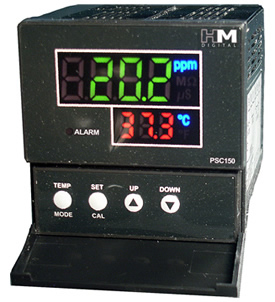

It’s no secret that one of the many factors in contributing to a successful reef tank is having pristine water, although some might disagree, generally that still holds true. The extended range TDS controller from HM Digital is a reef nerds dream. Besides looking cool installed next to your RO/DI unit it will monitor and control TDS levels for high output, has a large, bright L.E.D. display to show all your friends. Granted, this unit is “made” for commercial systems but what is that stopping you from picking of these up for a cool $189. It will measure PPM from 0-5000! It sure beats the 1000 PPM limit of that hand-held unit you’re using right now, doesn’t it? We’re not going to pretend to understand every spec shown below but we will gladly point you in the right direction. (click the read more link)
Specs
- Range: 0 – 999ppm
- TDS Range: 0- 5000 ppm
- Accuracy: ±2% f.s.
- Resolution: 1 PPM
- Calibration: Adjustable
- Setting: Controlled by on-screen up/down buttons
- Relay Control: The unit will transmit an analog signal to a pump/valve when the ppm levels reache or exceed the control settings
- Alarm: Steady beep (set by user)
- Display: Bright 5/8″ L.E.D. displays
- Probes: 1/2″ bushing, 3 meter (9.8 ft) shielded cable
- Power supply: AC 110V / AC 220V
- Dimensions: 2.8″ x2.8″ x 4″ (7.2 x 7.2 x 10.2 cm)
- Monitor Weight: 1 lb. 0.8 oz.