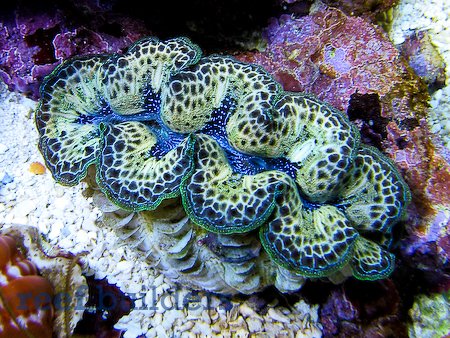
It’s not everyday that we get a new giant clam species but this week’s coral shipment to the LFS included a special sumthin for the clam lovers. Although T. derasa and T. squamosa hybrids have been around for years, the T. maxima x crocea (T. ‘maxea‘) hybrids have just recently become available from captive hybridization on the farm. The Maxea clams have a really unique appearance with blue and gold markings that lead us to believe that the hybrids are produced by a cross of gold and blue varieties of the two parent species. Not all Maxeas are created equal and there appears to be great variability in the appearance and vibrance of this new hybrid clam variety. The Maxeas are not too expensive, where a 2-3″ high grade T. maxima would sell at retail for $79, a similarly sized Maxea would probably retail for $99-$119.
Related Posts


This thing has 30 Comments
um… dude thats a normal crocea clam.. and no confirmed hybridization of any tridacnid species has ever been recorded…..
oh… another thing… a cross does not constitute as a new “species”
scratch that… T. costata is an identifyable species on its own but the likelyness of finding one at a petstore would be like a needle in a haystack as well as be illegal due to the fact that its endangered….
i figgured you were saying that a maxima x crocea is a new species.. which its not and doesnt exist…
I agree with Keith. Just a Crocea with scutes. No proof of hybridization has been recorded. Show me a link with proof.
The T.maxima x T.crocea hybrid clams originate from aquaculture facilities which explicitly cross the two species, they are listed as hybrids for sale and they look very similar to Crocea clams overall.
Umm I guess some one is dreaming
sorry mate its a Crocea that has not bored into any rock nothing, its a crocea clam aquacultured “nic looking ” but nothing to special ”
And not to be a pest here , but derasa clams x squamosa clams ? LOL ummm dont think so
Cheers Andrew
P.S no cross breeding has happened to date
Tridacna clam hybrids are very well documented from giant clam aquaculture facilties. The very rare Hippopus porcelanus is frequently hybridized with it’s closest relative H. hippopus when there is a lack of available mates. Derasa x Squamosa hybrids have been around for years and you guys will feel pretty foolish when you start seeing the Crocea x Maxima hybrids showing up at your local aquarium stores.
Keith– I don’t think Jake is claiming that this is a new species… I think the hybrids are just being called “T. Maxea” for convenience and maybe just to be cute.
I do believe this is a hybrid. I highly doubt the aquaculture facility would claim such if they weren’t. It just seems very unlikely they’d subject themselves to the liability of a scam that could so easily be found out…
ClamFan , i hope i am wrong , whos has the infomation , could you please post the link so i can read it .I can claim that i have hybrids but i have no proof of it .
cheers
I would like to see a hybrid also but there is no proof. That clam is crocea that came from selective breeding not cross breeding. In another article I read the man stated that left alone to spawn 98% of the offspring will be some kind of blue in color and 2% would have the rare colors. By selecting certain individual adults with rare colors and spawning them together you raise the percentage of colorful offspring. Ithink if they were going to crossbreed they would have done so hundreds of years ago.
Guys… it’s really not that hard to believe they crossbred these clams. It’s much harder to believe that a commercial aquaculture facility would out-right lie about having done so.
Tom- That kind of selective breeding takes decades and is likely not any more difficult/costly than crossing a crocea with a maxima. It also seems possible/likely that this cross has been done before, maybe even by accident, but for whatever reason… just didn’t make it into the commercial availability. Maybe the first few crosses were just ugly… or maybe not in enough numbers. Who knows? But I wouldn’t call these people liars just because we haven’t seen or heard about it until now…
Several months ago I picked up a couple of these ‘Maxea’ clams directly from the greenhouse of a very well known transhipper. He claimed they were crossbred from a facility in Vanuatu and only a very limited number were available. He probably only had a half a dozen of them, maybe a couple more at his place. I’ve seen thousands and thousands of T. maxima and crocea clams, however these definitely look different. I do believe they are crossbred.
As stated above the clam pictured is a crocea. I can think of one very good reason to claim its a hybrid, higher prices:)
Croceas and maximas are found together in their natural ranges, if they were going to hybridize they would have done it thousands of years ago yet there is not one DNA test to prove this. Also there is now scientific literature documenting this has ever been done. Above someone stated its well documented, well where is it?
Now if one was going to attempt to hybridize you would think they would start with two clams that are closely related, right? T. maxima and T. crocea are not each others closest relatives. T. croceas closest relative is T. squamosa. Crocea and squamosa diverged in the late Miocene (5.3 to 11.6 million years ago) Maxima diverged from the other Chametrachea’s in the middle Miocene (11.6 to 15.9 million years ago) Thats quite a large gap and plenty of time for them to have inter breed in the wild yet none have ever been found.
As for the well documented T. derasa and T. squamosa hybrids, where is the documentation? ive never found any. And again you would think they would use closely related species. Derasa and squamosa are about a far apart as you can get, squamosa being a Chametrachea and derasa being a Tridacna.
This is marketing hype, nothing more, and the seller is relying on people to just take their word and not actually try to id the clam. By simply looking at the shell instead of an unusual mantle pattern you can see that it is a crocea.
Its all in the shell folks
All I know is I have a tridacna gigas about 12 inches a couple croceas and a mixima and dersa I would definitly like one of these for 100.00 bucks. Where do I get one?
i am the importer of these clams, they come from a privatley owned clam farm in vanuatu. the breeder of the clams was hired froma nother clam farm to spawn these clams for us. he chose only colored teardrop maxima clams to spawn but left a few wild croceas in the spawing tank. (too lazy to remove them i guess. these clams are definitely hybrids, they require no cites permits to ship( they are recognized by the vanuatu government, which is watched over by the australian government, and by the us fish and wildlife service here in california as hybrids.) if you see an empty shell that have a shape not like any other maxima or crocea. if you do believe that they are hybrids then fine, dont buy any. your loss. any by the way 65% of the babies are black with blue stripes, 30% are gold, and 5% are green, multicolor, or the hybrid.
Brett, show me the genetic testing. You can email it here Chris@reefaquariumforum dot com
Having a few croceas in a tank with a bunch of maximas and then getting a few odd looking clams from the batch does not make them automatically hybrids. Look up Calumpong et. al 1993 They tried to do it with H. hippopus and H. porcellanus but it didn’t happen. They got a few odd looking clams but they did genetic testing on them and found that they were actually self fertilized, the H. hippopus they used fertilized its self.
If you have the testing send it over and i come back on here and tell everyone i was wrong.
Hey Brett, long time! Next time I am in your area I will stop by and see what you have, ofcourse if that’s ok with you all. It’s been a while since we have been elbow to elbow, picking out clams.
Tell your dad I said hi and give me a call when you get some of those clams in and I will come up.
Cheers,
Barry
Regardless of what they are I would love to see some more pic’s if possible?
http://picasaweb.google.com/nalabutch/MaxeaHybridClams?feat=directlink
try this link for pics of the hybrids. believe me if you want, this is not csi, i do not do genetic testing. have you been watching too much t.v. i guess we can take them to the maury show, you know, some hybrid clams, along with some adult maximas and croceas, and find out who the daddy really is.
So they haven’t been tested? So then you dont really know do you? You just claimed that they were exempt from CITES because they are hybrids. Did fish and wild life just take your word on this? I dont think so:) Even if they are hybrids ALL tridacna species are covered under CITES and would require permits. Did you just lie about importing them without CITES permits?
Just looked at the link, nice croceas! What makes you think these are hybrids? You do know croceas grow scutes right? How about some photos of the side of the shell and the byssal opening?
color never was, isn’t, and never will be a valid indicator of genetics/hybridization or even species for most inverts-the mechanics of pigment/pigmentation are just beginning to be understood, and i’m sure the seller isn’t one of the top in the field of pigmentation evolution/genetics, or even remotely close !
claiming to have hybridized two different species of clams is about as ridiculous as claiming to have hybridized a ritteri w/a bta-just because they’re both anemones doesn’t even mean they CAN be hybridized-i’ve seen two diff species of anemone spawn in the same system-the results were infertile eggs
the truly digusting and infantile thing here is the specific marketing ploy used-even with the ‘caveat’ provided-it’s purely false,misleading, and a classic case of ’sucker advertising’
to even claim something is a hybrid simply because some individuals of a diff species were physically present during the spawning of another is patently ludicrous
would have been far more honest to market them for what they are-very nice/slightly unusual croceas
. i never gave them a name, the retailers did. they are imported as cultured maximas and are perfectly legal. they have been pulled aside by several officers from fish and wildlife and no one could say really what they were, but that most likely they are hybrids. like i said before, if you dont like them dont buy them. your loss. i have called them hybrids because the fisheries biologist that spawned them told me what was in the tank when he spawned them. and by the way lots of corals can be hybridized, as well as fish and other animals, but just because someone tries it once and fails doesnt mean that it is not possible. the clam farm notified me that out of the entire spawn (over 25000 clams) only a few hundred came out like this.
“. i never gave them a name, the retailers did. they are imported as cultured maximas and are perfectly legal. they have been pulled aside by several officers from fish and wildlife and no one could say really what they were, but that most likely they are hybrids. like i said before, if you dont like them dont buy them. your loss. i have called them hybrids because the fisheries biologist that spawned them told me what was in the tank when he spawned them. and by the way lots of corals can be hybridized, as well as fish and other animals, but just because someone tries it once and fails doesnt mean that it is not possible. the clam farm notified me that out of the entire spawn (over 25000 clams) only a few hundred came out like this.”
LOL
you guys are dumb blah blah blah hybrids can’t happen… try telling this fish that… it did it OUT IN NATURE.
http://www.liveaquaria.com/product/prod_display.cfm?c=15+16+1683&pcatid=1683
granted I am not saying yes or no those clams are hybrids, but the fact that you guys are so hell bent on there being no way hybrid them doesn’t mean it can’t happen…
for the guy that said “Now if one was going to attempt to hybridize you would think they would start with two clams that are closely related, right? T. maxima and T. crocea are not each others closest relatives. T. croceas closest relative is T. squamosa. Crocea and squamosa diverged in the late Miocene (5.3 to 11.6 million years ago) Maxima diverged from the other Chametrachea’s in the middle Miocene (11.6 to 15.9 million years ago) Thats quite a large gap and plenty of time for them to have inter breed in the wild yet none have ever been found.”
were you alive back then? do we DNA test every clam? no? then shut up your excuses are horrible. How many clams are sold each year? how many are out in the wild? are each one of them tested? I didn’t think so you can’t claim that without proof either. Just because we havn’t found them doesn’t mean they don’t exist for sake you call yourself a saltwater know it all and you don’t even realize the most under discovered area is the ocean? you all are horribly sad crying about this
LOL!!!
-Chris go elsewhere to promote your forum. – RB Editors
dude you all are dumb for thinking that those are not hybrids… go to reefbuzz.com and search for the hybrids…. ask mr coral himself if he got a select few of these in and sold them in one day……………. they are real!!!!!!!!!!!!!!!!!!!!
There are VERY few publications describing genomic analysis of Tradachnid clams. I dont know that there is enough sequence data out there to define the two species based on DNA sequence polymorphism. I am a molecular geneticist at Harvard University. If anyone can provide me with suitable biomarkers and tissue from t maxima t crocea and the proposed hybrid, i would be happy to do the PCR and sequence the regions myself and provide you with an answer. if you have this info and samples, please post your contact info on this board.
Where are these maxea’s for sale? I have been waiting to buy one or two.
Some of you think you are the last source for all info, if you dont know it, its not possible metality. This is the same as all the new montis and chalices coming out lately. think about it…
This thing has 2 Trackbacks
[...] more on this, read ReefBuilders.com’s article here. Share and [...]
[...] Nissan Maxima Car Audio Wiring GuideClams images,Clams photos,Clams videos,Clams newsFragtoryMultiflora Linkia Starfish Tridacna ‘maxea’: New giant clam hybrid of Tridacna maxima x T … Joglosmart Tourism: [...]