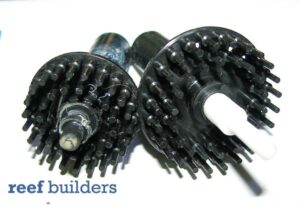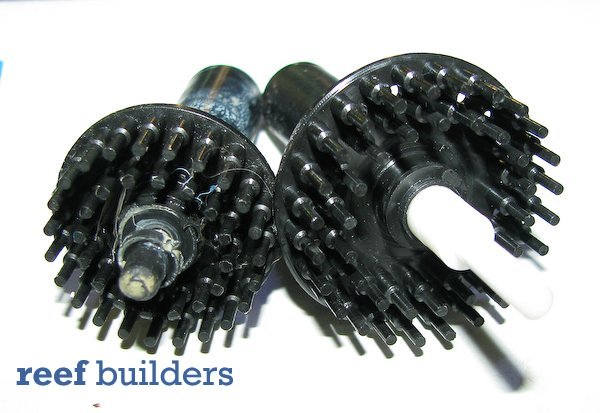

When design updates come along for a given piece of equipment, reefers are ecstatic when the performance increases by 10-20%. In the case of the H&S 90 internal protein skimmer (90-F1000), lucky owners of this fine german fractionator can expect a 50% increase in air intake while still pulling the same amount of power. The performance bump of the 90-F1000 comes from an improved aspirator valve and a new impeller design which replaces the traditional internal shaft bearing with a fixed shaft impeller and external bearings. In addition to the new magnetic assembly, the needle wheel also gains a greater diameter with more spacing between the pins and a series of holes in the needle wheel plate. A couple quick measurements at H&S USA HQ showed that the old design pulled roughly the claimed 120 lph of air at 4 watt power draw but the new needle wheel and aspirator valve pulled nearly 200lph with the same power draw. The new performance level makes it almost in line with the larger and more expensive H&S 110 internal skimmer which pulls 250 lph while drawing only 5 watts. All new H&S 90s already come standard with the new impeller and aspirator valve and the upgrade kit should be hitting Finsreef in the next few days with a pricepoint in the $50 neighborhood. Follow the break for images of the old and new needle wheel impellers and if you know the purpose of the holes in the needle wheel, please share your thoughts in the comments.