
I spend a lot of time talking and writing about marine biotope aquariums. As you may recall from my banter, a biotope aquarium is a system designed to replicate a specific environmental niche, such as a rubble zone, seagrass bed, for reef, etc. Putting together such an aquarium involves researching the environment that you are attempting to replicate, learning about the life forms associated with the environment, and then designing a system to accomodate the life forms. It’s an educational, beneficial, and exciting way to run a marine aquarium. Although the concept has been around the freshwater world for decades, fish-centric biotopes have been a bit slower to catch on in the marine community.
With the wonderful variety of marine fishes coming into the trade lately, there seems to be a revival of sorts among the lovers of marine fish; a renewed passion for collecting maintaining and breeding fishes. What a cool trend! So why not take it one step further and design and build a system just for the particular species that you are interested in? For example, if you’re like my friend John Coppolino, who pretty much lives, breathes and eats marine Angelfishes, why not design a system that supports their lifestyle? Multiple aggregations of rock, plenty of hiding places, and large open areas for the fishes to swim would suit most any Centropyge species of dwarf Angelfish. In addition to showing off these fishes at their best, such a system could afford spawning opportunities. Social interactions among these fishes are fascinating to watch, and are rarely seen in a “typical” reef aquarium.
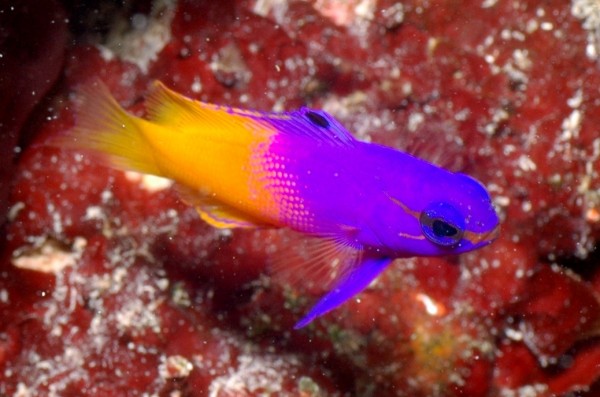
Another example of a fish-based biotope would be an aquarium replete with lots of rock overhangs and small caves, designed to mimic the biotope of that most famous “bread-and-butter” fish of the hobby, the Royal Gramma (Gramma loreto). This fish is found in modest-sized aggregations in nature, and displays fascinating social interactions when kept in groups. On a recent dive trip to the Carribbean, I was fascinated to see dozens of Grammas living together under rocky reef overhangs. Entire family units, ranging from big, old adults to small juveniles, were found almost everywhere I looked. What an amazing fish-based biotope to replicate!
Don’t want to devote a substantial aquarium to one species of fish? Why not set up a “nano” system designed to highlight a shrimp and Prawn Goby association?  There are numerous Amblyeotris, Cryptocentrus, and Stonogobiops species that form associations with small shrimps. These groups are often available for sale in aquarium stores and online, and typically are “lost” in the expanse of a large reef aquarium. However, in a ‘nano” aquarium of several gallons capacity and smaller dimension, such associations form the basis of a fascinating display. A deep sandbed with various sized rubble pieces and a few chunks of live rock is all that you need to “furnish” such a system. Of course, my usual admonitions about husbandry in small volumes of water apply, yet you can create a unique and educational setup with minimal effort. Once again, the opportunity to observe everday interactions- or even spawning behavior- is multiplied  in a system dedicated to a specific fish.
In addition to scratching that “itch” you might have to try something a bit different now and then, a fish-based biotope can serve the “greater good” of the marine hobby, providing you a front row seat to study the wonders of the fish world, and to share and report your experiences to other hobbyists on blogs such as Reef Builders. If even just a few hundred hobbyists made the effort to study one species of fish in such a manner, the knowledge base of the hobby would grow immensely, and perhaps  new secrets to maintaining,  spawning and rearing our precious friends from the oceans could be unlocked, for the benefit of all. A small contribution, but perhaps an important one- to help preserve and protect the world’s reef inhabitants for years to come.