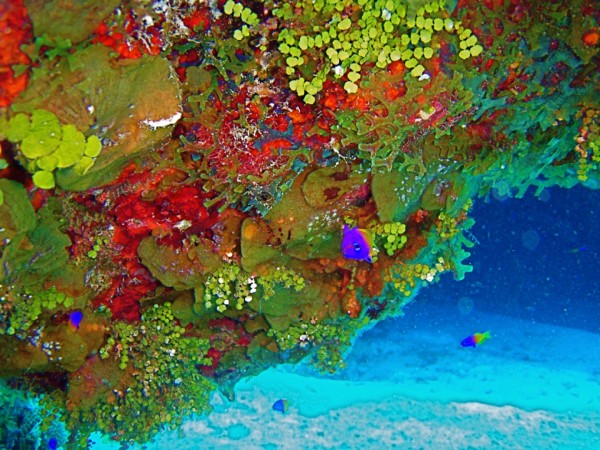
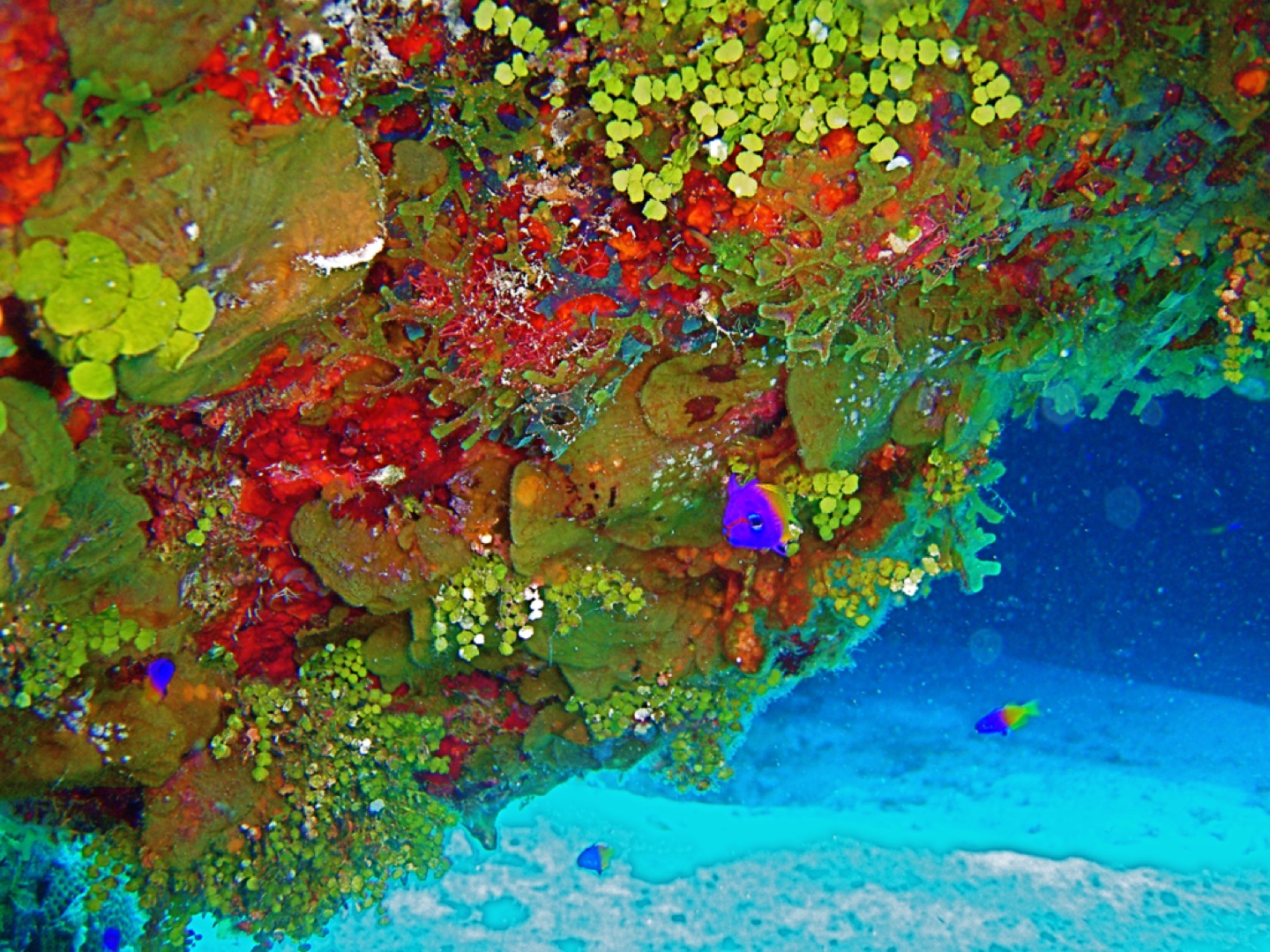
As a dedicated fan of  marine biotope aquariums and unique concept aquariums, I’m always trying to look at natural reefs for inspiration. I mean, if nature does it, it must be good, right? And you never know where that next cool idea may come from. A case in point: My girlfriend Michelle and I were  on  dive trip to the Caribbean. On this day, we were diving in Belize (an amazing place for  biotope geek, BTW), and my obsession during this whole trip was to observe Royal Grammas in their natural environment, which I did extensively. Michelle took a lot of pics, and we saw some really cool stuff. One of the things I noticed was just how much macroalgae there was on the reef: In addition to the colorful encrusting corallines, there were tremendous growths of Padina, Halimeda, and Dictyota, all growing in a sort of lush, low carpet over the rock, with little patches of sponge and gorgonians here and there. A really colorful assemblage, to be sure!
After we downloaded the photos, I really started to examine them carefully, and it dawned on me that as hobbyists, we include macroalgae in our systems in only the most rudimentary way: a sprig or two of Halimeda or (gulp) Caulerpa here or there, Even in the so-called “macroalgae gardens” that I so admire, the macroalgae rarely seem to be more than artistically planted here and there…I thought to myself, “Why not plant macroalgae to mimic how it occurs on the reef?” NO, seriously..! And what’s really funny about this is that I am trying to embrace my sworn algae enemy- Dictyota!  I’ve had notable battles with this stuff over the years, with it typically kicking my butt and smothering my delicate corals. I really learned to hate it and considered it a total nuisance!  However, when I saw the way it occurred in nature, I began to appreciate the subtle, luminescent quality that it possesses. It’s actually attractive! (I say that because I’m not the one trying to pick the damn stuff out of my rare Acropora colonies at the moment!).
In other other words, embrace the creeping Dictyota! Gasp- I never thought I would say that. I mean, the stuff grows thick and low over rock, and if you try to pull it off and a few pieces get loose, they end up all over the tank. So why not just let it do it’s thing? Â When life gives you lemns, as they say…Yup. Start with some of the most colorful pieces of live rock you can find. The wonderful “Pukani” rock often available is a great choice for color. Â Attach some patches of Halimeda here and there, and let it establish itself. You’ll need to provide appropriate conditions: moderate flow and “SPS”-like calcium and alkalinity levels. Once the Halimeda establishes itself, be sure to attach a few colorful Grogonians, and perhaps a few smaller rocks covered with Padina (you can find this unmistakable macroalgae on live rock very frequently). Then, after a few weeks, introduce (yikes- I seriously cringe when I suggest this!) a small rock with a patch of Dictyota on it. You can easily get this from a fellow reefer..Just ask who’s battling this stuff and they’ll provide you all that you want…for free! After they stop laughing, of course.

After a few weeks, you’ll see the Dictyota do it;s thing. Your Halimeda will be cranking, and your Padina will be- well, doing whatever Padina does. And you’ll be on your way to a very realistic replication of a slice of the reef…And think about it- you won’t need to worry about Dictyota becoming a nuisance- because very reefer knows that when you’re TRYING to grow something, it’s always difficult! If there is one thing I hope that you get from this post, it’s that everything has a niche on the reef, and you can replicate it with some creativity and effort. You’ll develop an entirely new appreciation for life on all levels, and for the amazing diversity of life on the reef.