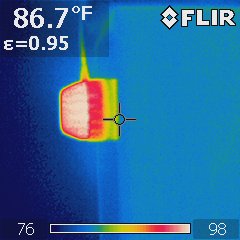
We really don’t know what is better. Owning a vortech, or owning a vortech and a thermal camera. That is exactly what one hobbyist has. A Thermal Camera. He hooked up his thermal camera and took some snaps of warm items around his house. The Vortech is the most impressive by far. And we are surprised how hot the motor unit gets, if we were a betting blog we’d probably wager that some of the heat gets transferred back into the tank. Go have a look at the full gallery.
Update: our very own Jake Adams has personally used a calorimeter to measure the heat added to an aquarium by a vortech water pump. At full intensity, an MP40 will add 15 watts of heat to an aquarium. Every other water pump will add exactly as much heat as it’s power rating therefore a 40 watt water pump will add 40 watts of heat as the kinetic energy of water flow degrades into thermal energy.
Related Posts


This thing has 23 Comments
Eh, I dunno how much of the heat would actually be transferred into the tank. Kind of hard to see but the back panel looks all uniform in color meaning its all the same temp, so it could be a matter of yeah the back side is hotter, but it's be dissipated before it gets to the tank, the glass/acrylic isn't a half bad thermal insulator. Even if it wasn't it looks like there might be a 6.7° temperature gradient at most (assuming 80°F water), and looking at the colors green to light blue, the temperature difference is pretty close.
Ryan- You'd be betting wrong.
As Mike said above the motor itself is a heat sink and made from aluminum. There are multiple layers of rubber between the pump and the tank acting as insulators and you can clearly see that depicted as green in the image above. By the time you reach the glass, the surface temperature is as cool as the room. Glass in and of itself is a great insulator. The heat from the dry side of the VorTech does NOT penetrate the glass.
Another way of looking at this image is to view it as how much heat would be dissipated INSIDE your tank were you using internal pumps.
I have used a thermal imaging camera before and unfortunately, you cannot image the infra-red rays through glass or water. If you could, you would see that ALL the heat produced from internal water pumps is being transferred to the water. It would look like a plume of heat coming off your powerheads.
I posted a high temp of about 85 (cant remember exactly) when I shot a laser pyrometer at one of the Vortech's at MACNA… and posted it at RC with the MACNA pics. That pump might have been on a wave timer though, explaining why it was cooler, and this one above I would assume is running at a higher pulse or higher constant speed. Those temps aren't that bad, and they are also relative to the size of the pump. Just imagine 'how much hotter' these things would look if they had less surface area and the same wattage, or how much cooler they would seem if they were 2x as large at the same wattage. A surface temp is rather useless because it only shows heat buildup, not how much heat is being moved to the surrounding environment. 'ALL THAT HEAT' could be from only a few watts and poor air circulation, or it could be from 100 watts (okay, not possible in this case) and good circulation. I suppose they could put radiator fins on the outside of the Vortech to spread out that heat, but the end result would be the same.
Also, I dont know how you came up with that calculation of 15 watts of heat energy, or how its applicable. Dont forget that the mechanical energy that actually moved the prop also translates into energy and therefore heat when its moving water in the tank. The only energy or heat that actually escapes the tank is what heat happens to convect from the external motor to the air. For example, if that pump was internal, like a Tunze, and running at a full 40 watts, even at 90% efficiency, that would mean 40 watts of energy and therefore heat would be put into the tank because the mechanical energy that the pump is putting into the tank. Some people with ponds keep them from icing over in winter just by leaving the pumps on…. not that the pumps are hot enough to warm the water, but that the water circulation and movement translates into heat. Since most electric motors are at least in the 50% efficiency range (unless its total crap), its a safe bet that when these motors are running at 40 watts, they are putting about 20 watts of that into the tank.
Hey Jon http://tinyurl.com/nme63j
I don't know what I'm more jealous of, the fact Jake has the equipment hanging around that he can easily set up an experiment to measure the heat from a vortech, or the fact he has extra vortechs simply sitting around to test on
That being said, I still think the points that were being made earlier by myself, and Tim is that the motor itself is not what is putting "heat" into the aquarium are still valid, but the prop that is slapping the water around is what's increasing your entropy
hey Jake… how did you use the calorimeter to get 15watts? Did you run the Vortech through the wall of the calorimeter? That would mean that the Vortech has less than a 37% efficiency. Ouch.
Jon-
You're leading us in the right direction. I'm not familiar with Jake's study, so I'll let him chime in on that one.
The surface temperature is a function of the total heat dissipated, the surface area, and the thermal conductivity of the heat sink. As you said, if our dry side was bigger the surface temperature would be lower (given the same power input), if our dry side was smaller then the surface temperature would be higher. While the overall efficiency of the system is a factor in this, high or low temps on the heat sink don't provide any indication of whether our unit is efficient or not.
Let's say a VorTech and an internal prop pump are both running at 30watts. As you know, wattage is not heat, it's power. If a pump is 50% efficient, 50% of that 30watts is being converted into work, and the other 50% is being lost to the surroundings as heat. Either way, a 30watt internal pump will put 30watts of power in your aquarium. Same as a 30watt heater.
The VorTech, however, has it's motor outside the tank. Therefore the conversion from input power into work and heat (the ratio of the two being efficiency) occurs outside of the water. Again let's stick with 50% efficiency; so 15watts is being converted into work within your aquarium and 15watts is dissipated as heat on the motor. OUTSIDE the tank.
This is a simplified model, but it explains the premise.
Jon-
Regarding efficiency, as aquarists what we need to be concerned about is not the efficiency of our motors but the efficiency of our pumps. What I mean by that is ultimately what we care about is the GPH produced for any given input watt. Efficiency factors beyond this really don't matter to us. Not all pumps create the same amount of flow for a given unit of work from the motor. Flow efficiency is further determined by bearing efficiency, rotor design, intake area, output geometry, etc. Not all propeller pumps on the market are created equal with respect to this.
I can tell you based on our testing, our pump is VERY efficient with respect to this criteria.
Gotta love the science coming out
The laws of thermodynamics has reared it ugly head
My calorimeter was basically a styrofoam cooler with 3/4" thickness all around. I chose a container which could be completely sealed and purged of air. I don't know why you keep saying that Vortechs draw 40 watts when I usually see them draw 27-28 watts when running full bore, with peaks of 32 watts when in maximum pulse mode. By my calculations the MP40 is pushing over 50% efficiency which is a very respectable number, I doubt any water moving device can push over 60%.
Sorry, I thought they were called MP40W's because they were 40 watts (I think that part in the article about a 40w pump actually putting 40w into the water is what got me thinking that). I was wrong. Okay, so you set up the pump to run through the wall of the calorimeter, 3/4" thick though… that calorimeter is bleeding heat then too. This is a good thing for the motor though… it might be putting more than 15 watts into the water.
As for % efficiency for movement devices, the electric motors can easily hit 90% efficiency if designed right. In general, most US companies are behind in terms of efficiency, while China & Japan are great at DC tech, and many EU companies have been using PFC motors that for some reason US companies cant figure out how to make. I just wanted to know how you tested, and wanted to say that I cant figure out what conclusions one could make based on a thermographic image alone.
One conclusion you can make from the thermograph is that the "motor" doesnt actually transfer much heat through the tank wall at all. The temperature labeled in the top left is 86F and this is the actual surface temp at the point of the crosshairs in the center of the image. The other thing you don't see is a radiation of heat through the glass wall, radially away from the pump. This indicates that there really isnt enough heat coming from the motor of the Vortech.
I think the motor of the first prototype vortech may have been 40 watts but that number was brought down significantly in the beta and then production grade pumps.
Glad you cleared up the science more. I dont think I did that clearly, but I didnt know what figures I was working with. What got me questioning everything was just the idea of shooting a thermographic image of something as some indicator of efficiency or actual heat output. Its like the Sicce PSK 2500 vs. the Eheim 1260… both commonly used skimmer pumps now. The PSK feels HOT to the touch, but the thing is, its actually less wattage. The 1260 feels cooler even though it uses about 2x the wattage, but look at the motor sizes… the Sicce is almost the size of a powerhead, and the Eheim is a moose. Its a bit like how people observe T5's being cooler to the touch than a halide, and therefore say that they make less heat (per watt), which is totally false since its a function of surface area, and the heat output per watt is actually about the same, and if you take into account the radiant energy produced, they are identical. The thermographic image of a pump is like trying to tell how fast an athlete is running by taking a photograph. The calorimeter thing is also sort of a useless number… as you mentioned Tim. The more 'heat' the motor adds to the tank for a given wattage, the better.
I really dont see the big deal here. If someone was that worried about their system temperature then I would look at the lighting and main system pump before looking at a small prop pump. Personally, I run two Vortechs in my system and my temperature actually dropped after installing them. But, that could also be due to the fact that the two Vortechs replaced four Tunzes. I love my Vortechs.
Jon-
I believe you and I are on the same page.
I do argue however, that the calorimeter test does not produce a useless number. Based on what Jake has mentioned above, this test concluded that in fact the VorTech pump is doing as designed, and inputting far less heat into the water of the aquarium relative to the power being consumed to create its flow. No other propeller pump on the market is capable of doing this, no matter how efficient it is or isn't. Sonny- this is why you noticed your tank's temperature decrease, and you are not the only VorTech user that experiences this.
At the end of the day the important thing to take home with respect to this image and the content of the original blog post is that our pump DOES significantly reduce the amount of heat added into the aquarium compared to any other propeller pump on the market (when comparing watt for watt, flow for flow).
Based on our discussions (great ones too! How often does that happen?), this is not a subject of debate but one of science. Further, this thermal illustration does eliminate the conjecture that some of the heat dissipated from a VorTech pump outside the tank is conducted back into the water through the glass. This is simply not happening, or if it is, it is incredibly minimal and non-measurable.
i have 6 vortec's they do not heat up my tank
Well, wouldnt you mean though that its putting more heat into the tank (or calorimeter), from what you said in the first paragraph there? Considering any heat that the motor makes gets shed through the outside air… the only thing that would matter is to add the most heat possible to the tank for a given wattage, since the 'heat' would be a byproduct of the water motion in the tank… the more, the better. For example, in the case of the Vortech, if there was a way to increase the calorimeter reading while keeping the pump at the same wattage, that would be a good thing. Saying it puts more or less heat into the tank vs. the outside air is rather pointless. If you were to make the exact same pump somehow more efficient, it would result in less heat on the outside, and more heat going into the tank through work.
I suppose, if you are trying to say that the thermal heat generated by the motor on the outside doesnt go to the inside, that might be important. but its on glass after all, which is a rather good insulating ceramic. If the motor was 2x the wattage, but 1/2 as efficient, the heat going into the tank would be the same. In the end all it means is that the pump can move alot of water for less wattage… but regardless of if its coupled through the glass like an Iwaki or in the water, the benefit is equal.
Its the equal and opposite of using compact fluorescent lighting vs. tungsten in a home with electric heating in a cold climate. Neither saves you more money on your electric bill because while the tungsten uses more watts to get a given output, the remaining power goes to heat which helps heat the home, so the furnace works less.
Well… they DO heat up your tank. The concept we are talking about here is that the work of moving the water is a form of energy which translates into heat. The more water you move, the more heat you are adding to a system… The calorimeter is somewhat useless because all it shows is the net heat/energy being put into the water… but that heat energy comes from two components… the motion from the propeller is one, and the regular 'temperature' is the other. So a calorimeter does little to clarify anything other than the net energy being put into the water (and then we can reason that the rest of the wattage is heat on the outside). The motion of the water IS a form of thermal energy though. To find out how much energy is being transferred to the water as raw heat vs. work would require a more elaborate testing method.
If any heat comes through the rubber and glass, I bet it is less than someone sticking their hand in the aquairum.
If you mean raw thermal energy, as in the most commonly used definition of 'heat'… yes… glass is a great thermal and electrical insulator. But the magnetic coupled propeller that transfers EM work to the water inside the tank is also a source of heat. Moving water might not seem like an obvious source of heat, but it is (as water with no heat is… well… frozen). A more obvious example would be a power tool like a belt sander. The motor itself makes some heat since the copper and magnets warm up, and this heat is vented. There is also heat from friction though, and not just internal gears and wheels, but the friction of the actual grit as it moves over the surface being sanded. Likewise, there is friction being generated not only from the internals of the motor, but from the water 'rubbing' against its surfaces, from it experiencing a drop in pressure as it is taken in, to when it is discharged under higher pressure through the front and it runs into the rest of the liquid in the tank. This water motion and friction due to viscosity and changing pressure is how water flow converts the work and motion of a pump into heat for the water.