This thing was constructed on September 12, 2009, and it was categorized as Reef Aquarium.
You can follow comments through the RSS 2.0 feed. You can skip to the end and leave a comment. Trackbacks are not allowed.

wal

One of the biggest problems for most hobbyists when incorporating live rock into their display is figuring out how much live rock needs to be used. In the “old days”, it was thought that you needed up to a “few pounds of rock per gallon” to help “filter” the water . In our desire to get our hands on one of those new-fangled reef systems, we heeded the expert advice of the time and loaded our aquariums with huge quantities of live rock.

After “prepping” your significant other, family, or roommates about the wonderful  process that was about to unfold in your own living room, you excitedly ordered your “required” 400 pounds of live rock from your Florida-based supplier. In just a few days, UPS would deliver that stinky, wet box of Florida “roadfill” (let’s be honest, that;’s all most of that crap was!), complete with the “Please keep warm- Live Tropical Fish” stickers on the sides (that always made me scratch my head!). If you were lucky, there might just be some genuine marine life, such as an Aiptasia anemone or  some Valonia “Bubble Algae” clinging to life on the putrid, dirty rock. After the requisite “curing” process, it was then time to get that stuff into the aquarium!

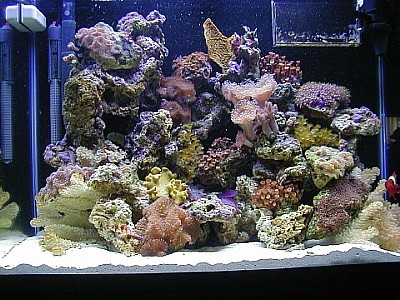
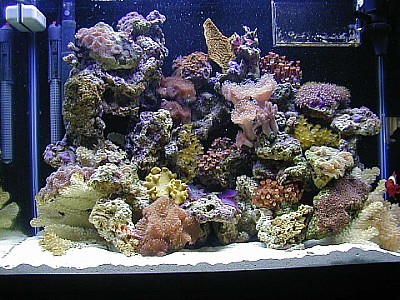
How do you fit 400 pounds of rock into a 100 gallon, 60- inch-long aquarium? You guessed it- you STACK it in a big pile to form…a ROCK WALL!  That’s right…the rock wall- that hideous, unimaginative aggregation of  live rock, running end-to-end across the aquarium, from top to bottom. You knew you arrived when couldn’t see anything but rock in the aquarium! A real reef in your own living room!  Never mind the fact that you couldn’t get a fish net into the tank, or that you had to abandon in place any powerheads that failed because you couldn’t get your hand in the aquarium to retrieve them.

Unfortunately, the 1980’s (a decade of great music, wacky hair, hideous fashion, and unabashed decadence) seems to be alive and well in the reef hobby today. In almost every club that I visit around the country, I run into example after example of the rock wall. Sure, sometimes the rock is festooned with colorful corals or invertebrates, and sometimes there are lots of cool fishes swimming around (as well as they can, anyways), but it all looks the same to me…endless rock and  no variety.

I have to borrow words from President Ronald Reagan, spoken at the Berlin Wall back in 1982: “…tear down this wall!” Much as the President pleaded with the leader of the then-Soviet Union, I admonish you to recognize that it’s a new century and that we have to embrace new aquascaping possibilities: TEAR DOWN THE WALL!!!!

cre

A well balanced aquascape produced by coral reef ecosystems

Besides, think of the liabilities of clinging to this outmoded hobby icon of a bygone era: When that “designer”  ” Acropora expensiva”frag that you just forked out 95 bucks for gets knocked over by your Sixline Wrasse and falls behind the rock wall, you know that you’ll never see it again…At least until you wise up and tear down that wall of rock. How can you get a siphon down there to do water changes? (You DO make water changes, right? Yeah…thought so). Circulation? What’s that? Ok, you get the idea…Enough of the rock wall already!

So how much rock DO you need? I get this question as often as Sanjay (Joshi) gets asked “What’s the best metal halide bulb?” In my unbiased opinion, you need only enough to complete the aquascape that you are envisoning, and that’s about it. Nothing more, nothing less.

Now it’s time to put my money where my mouth is, and give you some alternatives to the wretched rock wall. In future installments, we’ll take a look at some rock configurations that you can use to send the rock wall back in to the dim recesses of hobby history where it belongs!

Off my soapbox for now…

Stay Wet,

Scott Fellman

Other items you might enjoy:

This post was written by .


search more: , , ,

This thing has 17 Comments

  1. Chuck
    Posted September 12, 2009 at 4:21 pm | Permalink

    Hurrah!

  2. shaun s
    Posted September 12, 2009 at 4:29 pm | Permalink

    I abandoned the rock wall when I set up my 75gallon(1.5 years ago). Interestingly, this happened about 6 months after I started to take interest in planted aquariums. I did load 40-50 lbs. of rock into the first chamber of the largest sump/refugium(45gal) I could fit under a 75. Then lined the bottom of the tank with 30 lbs. of rock and covered that in an inch and a half of sand.Using the rock on the bottom of the tank as a base I stood 5 pieces of rock(15-25lbs. each) on end and that is my aquascaping. It does require several frags to be glues to the same rock, since colonies on rocks are hard to place without looking out of place. Very little detritus collection and 360degree corals on rocks. I will never build a wall again. Can't wait to see what options you suggest with all of your biotope experience.

  3. Jon
    Posted September 12, 2009 at 10:41 pm | Permalink

    I like using 1/4" plates of acrylic buried under the sand. I drill and tap them with dozens of 3/8" holes & threads. Then I cut up some 3/8" PVC rods (they come in a medium grey), bend them as needed with a torch, and cut them to the lengths I want. These PVC rods poke up through the sand a good 2-3 inches, and allow me to perch my live rock right on top of them. Usually, I will make a 3"x5", or a 6"x6" plate, and place up to a 10×12" rock on top. This way, the rock is up off the sand, increasing the flow in the tank as well in a dramatic way, as well as eliminating dead spots. If I want to create a pillar (I often do), I will place a much longer PVC rod right in the center of the shorter ones, and use a ceramic spade bit to bore out a center hole in my rocks. Then I just stack the rocks on the rods, with the central ones going through. The cool thing is, in the shadows under the rocks, you cant really see the support rods because they are grey and only 3/8", and because they are spaces out so the rock on top of them has a significant overhang.

  4. Jon
    Posted September 12, 2009 at 10:49 pm | Permalink

    ^^^ the pillars can be narrow and look like they are floating, with plenty of mounting space. There is nothing on the sand except for what blows to the front (the flow takes on a gyre motion) where the LPS and clams are. The pillars look like they are floating.

    Next project… eliminate the dead space that so many of us have in the back corner of the tank, esp in tanks 24" and wider where this ends up being a dead-zone. The solution is to slope the bottom… tall in front, shallow in the back. This allows me to have a much wider tank as well w/o the access problems to that dead zone. Since sand cant be kept on that slope, a 'fake floor' of aragacrete is the best option, which allows me to make frag holding formations and 'boulder holders' right in… or even caves. The only sand is what I put in the trough in the front. The shallow area in the back is for frags and hiding the tunzes. This also means that the space under the back of the tank can be pretty tall in the back… I could put a very tall sump or skimmer back there and not have clearance problems since the tank is a good 54" off the ground in back…

  5. Jon
    Posted September 12, 2009 at 10:53 pm | Permalink

    Drat, that didnt work… just check out the concepts at the top of my album and tell me what you think…
    http://s90.photobucket.com/albums/k278/wetworx101...

  6. pmason44m
    Posted September 13, 2009 at 1:23 am | Permalink

    ^^^ Holy skimmer! in your album… very nice work for the tank concepts too!

  7. Mike
    Posted September 13, 2009 at 2:07 am | Permalink

    Bravo Scott!! I'll admit when I started (about 2 decades later than the 80s) I fell into this "trap" where my beautiful 135g aquarium had about 180 pounds of dry rock with 90 pounds of live rock and yeah it looked pretty rockwallish….. Now with my 180g I probably have on the order of 90 pounds if that, and not in one big pile either, there's canyons and crevices, and more open water than rock filled water, and the only thing obstructing my flow is the growth of the corals.

  8. chase
    Posted September 12, 2009 at 9:59 pm | Permalink

    do the type of people who read this blog really still have the rock wall aquascape going on? seems like old news

  9. jake adams
    Posted September 13, 2009 at 3:30 am | Permalink

    You'd be surprised how many people are still building the wallingest rockpiles. Unfortunately, good reefscaping etiquette is still uncommon knowledge

  10. Posted September 13, 2009 at 4:51 am | Permalink

    Don't be a hater chase

  11. algaeguy
    Posted September 13, 2009 at 6:46 am | Permalink

    Chase, good point that the majority of the RB crowd is beyond the “rock wall”, but I am absolutley shocked at how often I see this wretched configuration still. I can only hope that we can all share our unique aquascapes to inspire our fellow reefers to try something altogether new.

  12. chase
    Posted September 13, 2009 at 7:53 pm | Permalink

    if anyone on this site has a rock wall, I’m coming to your house to knock it down! we call that reef justice

    okay I’m done hating guys

  13. Jon
    Posted September 14, 2009 at 2:32 am | Permalink

    Walls have their place too… I make aragacrete plates that actually cover the back wall of the tank and overflows as my 'background' rather than the typical black or blue painted back. Why not use that back wall as rock space to grow corals rather than algae?

  14. adrian
    Posted September 14, 2009 at 12:57 pm | Permalink

    well said

  15. Posted September 15, 2009 at 3:56 am | Permalink

    Down with the rock walls! No rock wall here: http://www.rimlessreef.com/photo-gallery.html

  16. Scott Fellman
    Posted September 15, 2009 at 1:33 pm | Permalink

    Sonny, that tank really rocks! That's yours, right? I'm liking the bommies! Would love to use some pcs in my aquascaping presentation!

    Scott

Post a Comment

Your email is never published nor shared. Required fields are marked *

*
*