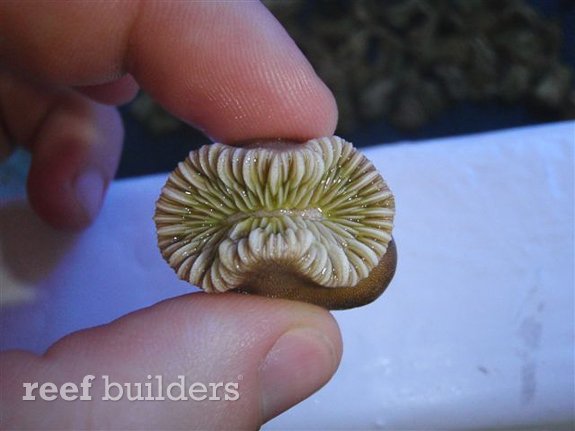
Heteropsammia is a coral which has never been seen alive in the aquarium trade. It’s not everyday that a truly unique coral is imported for the first time but thanks to the efforts of Sea Dwelling Creatures, the US hobby will soon be graced by the presence of Heteropsammia cochlea, the “walking dendro” coral. There are so many features that distinguish Heteropsammia from other corals that we can’t wait to see this coral more widely available in the trade. For starters, Heteropsammia lives unattached from the reef, preferring instead to settle on a sipunculid worm which it then grows around. The base of the coral has a small hole where the worm can extend it’s feeding parts and the worm also moves the coral around in the soft sandy substrates where it lives. SDC tells us that you won’t believe how much this coral moves around in the sand. Although the coral resembles Dendrophyllia and Balanophyllia, the species is actually photosynthetic and it extends brown and green tentacles during the day. All but one of these specimens of walking dendro went to public institutions but we’ll be reporting back on that one exception as soon as it is settled in and more photogenic. Big thanks to SDC for giving us the lowdown on this coral while it was still in Australia and for sharing these images with Reef Builders and our readers. Check out the gallery below for a 360 degree look at what makes this coral bizarre and unique, we will soon follow up with more images of the extended living coral polyp.
Related Posts


This thing has 11 Comments
I wonder how strong the sting is? Will it run around harming other sand dwellers and corals lower down within it’s reach? Regardless… way cool
I don’t know about the coral’s sting G, but being related to dendrophyllia and balanophyllia it should have the potential to pack a high density of nematocytes in it’s tentacles.
It’s not the first time this coral has been imported, however it is the first time this coral has been imported legally…
Thank you for sharing information on this coral. It is very interesting, too bad it is photosynthetic. I wonder if the coral is as hardy as a Dendrophyllia and Balanophyllia and if there are any difficulties keeping the sipunculid worm alive.
On a different note; is there any CITES issues with bringing in this coral? or is that being sorted out?
This coral is being collected from Australia, which has a CITES permitting system based on tonnage. Therefore the Aussie coral collectors can export any stony coral as long as it is properly identified.
Ali,
What do you know?
Mr. Alireza has been hustling the black market corals since 1972, he would know!
@ Mike L- COTW lists this species as possibly azooxanthellate in temperate and deepwater habitats. Being related to Balanos and Dendros, I imagine that this coral would do just fine without light if you fed it well.
Hehe…
The guy I know who has one picked it up at a LFS a couple years back when Aussie stuff was just trickeling in. It probably came in as a duncan or dendro, who knows.
I actually called him a couple days ago to verify if he still has it and sure enough he does. He never feeds it, so I guess they are photosynthetic.
I got mine today! Live Aquaria has been posting them in the divers den.
My two specimens of this species LOVE to eat, and move around a TON. Every morning i wake up and play find the Heteropsammia!
Nice write up, but the coral settles on a bivalve or similar first. In one area in Queensland it may use empty hermit shells. So depending on what you’ve got, you can find yourself looking at a bizarre symbiosis. The other day my worm travelled 18″ overnight (after I had moved it) and returned to the same area where it had spent the last few days. Finally, I wouldn’t hold my breath about the organism being correctly ID’d, as I’m told it could also be Heterocyathus sp.