Sometimes the best discoveries in science are happy accidents, and this year researchers at the Canadian Centre for DNA Barcoding uncovered some genetic data which supports ideas that hobbyists have been suspecting for years: namely, that some fishes we assumed were separate species may in fact be one (or ‘conspecific’).
Among those fishes masquerading as separate species are some groups of clownfishes, butterflyfishes, and tangs. This should come as no surprise to hobbyists who have kept pairs of these or seen them in public aquaria, as multiple reports of these hybridizing have been seen over the years. So let’s take a look at what we mean by hybridization, species, and how the heck do you barcode a fish?

In high school biology we learn that a species is defined as a group of organisms which can interbreed and produce fertile offspring. So, a cat is a separate species from a dog. Of course not all dogs are created equal, and while a Chihuahua may not look anything like a Rottweiler, in fact they could breed together to produce a very strange looking mutt. This definition of “species†stood strong until the molecular biologists started looking at the actual DNA of organisms to see not only which animals looked the same on the outside, but which organisms looked the same genetically. Here’s where DNA barcoding comes in.
 Some genes are universal to all living things—there are some proteins (and the genes which code for them) which we all have, from bacteria to fishes to humans. While these proteins perform the same function in the same way in each organism, there will be some small differences in the DNA code from individual to individual, and it turns out that the more related two species are, the more alike their codes are. So to ‘barcode’ a fish, a researcher will take that fish, grind it up, extract the DNA and look at the code for ONE single gene and compare it to the same gene in another fish. If two fish are the same species, they expect the gene to be less than 2% different (so our Chihuahua and our Rottie will share more than 98%).Any more than that and the fish are considered different species.
Lo and behold, some surprises came out. First we’ll consider the Pink and Orange Skunk Clownfishes (Amphiprion perideraion and A. sandaracinos), which look similar except, well, one is pink and the other is orange. These have been considered by hobbyists and researchers alike to be two separate species, but in fact their genes hardly differed at all. In practical terms, this means that pink and orange skunk clowns are likely to interbreed successfully given the opportunity.
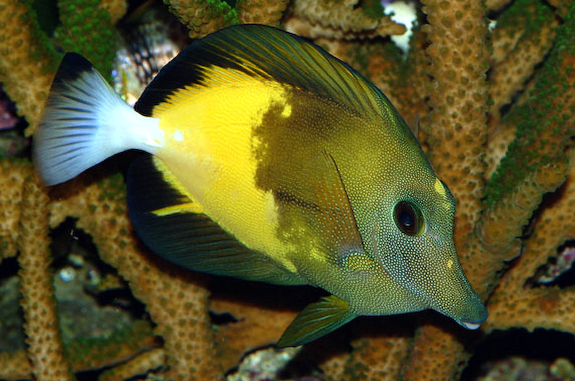
In fact, there have been many hobbyist reports of hybridization of various Amphiprion species, and it may be that more of these so-called species are merely different color and pattern variants of one species. Second, the Spotband Butterflyfish (Chaetodon punctatofasciatus) and the Pebbled Butterflyfish (C. multicinctus) also were essentially indistinguishable, though these are less commonly seen in the aquarium trade. Lastly, and perhaps most surprisingly is the new revelation that the Yellow Tang (Zebrasoma flavescens) and the Scopas Tang (Z. scopas) are more than 99.7% identical, meaning that the Scopas and the Yellow tang are likely just different color morphs of the same fish and also could interbreed in the aquarium.

Why is this so, and more importantly to RB readers, why does it matter? There are several theories as to why these fishes seem like different species but may not be. They could have diverged long ago from a common ancestor, lived happily as separate species, but when the fish pickings get slim (you know, the Reef Bar is closing and there aren’t enough hottie conspecifics to go around), fishes will sometimes try to mate with the next best thing in this case, perhaps, another Amphiprion species. Alternately, in the case of the tangs, it could be that these two closely related fishes are still in the process of diverging into completely different species and we are catching evolution in action. Given no Yellow Tang mates in a tank, but a suitable Scopas, they may revert and interbreed.
Kissing Cousins? Perhaps. Either way, it provides some really interesting groundwork for aquarists looking to create some new “hybridsâ€. Yellow Scopas, anyone?
Further Reading:
The Venerable Scopas Tang– by Greg Schiemer
Barcoding Nemo: DNA-Based Identifications for the Ornamental Fish Trade