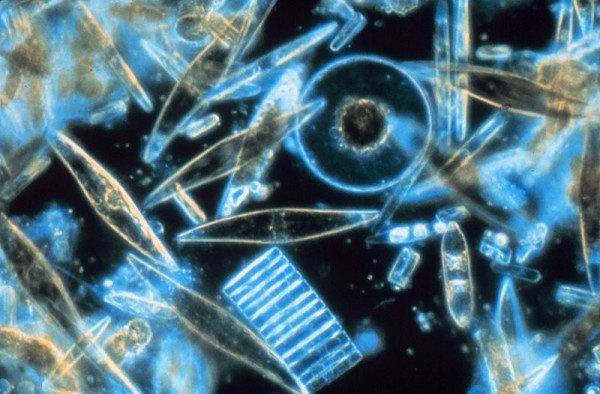

It has been long held that silica in reef tanks is bad, very, very bad. We avoid beach and play sand like it’s poison because it is believed that silica will cause an undesirable diatom bloom: brown glass, brown gook on rock and substrates, and unhappy reefkeepers. But what if we could control this system and use it to our advantage…say, to increase nutrient export? Let’s take a look at some old data, some new data, and a controversial hypothesis regarding the intentional dosing of silica to our reef aquaria.
Diatoms take many shapes (the photo above, by Dr. Gordon Taylor of the School of Marine and Atmospheric Sciences, my academic “homeâ€, shows a collection of polar diatoms). It is well established in biological oceanography that diatom blooms occur when seasonal upwelling of nitrates combines with longer sunlight and warmer spring waters. These diatoms can exist as benthic coatings, like the brown coating we see in a newly cycling tank, but the bulk of them in the ocean are in the water column. Once the diatom bloom commences, nitrate levels drop precipitously until they can no longer support growth, and the diatoms are either eaten by zooplankton or fall to the bottom of the sea. One thing that is unique to diatoms is that they build shells out of silica, or “testsâ€, which are symmetrical and some of the most beautiful creatures you will find.
The Old Data: Because we have all learned the dogma that “silica is badâ€, silica levels in our tanks are typically way below the level found in reefs (Randy Holmes-Farley, 2003 ). As a result diatom growth is silica-limited, so the diatoms are not performing one of their useful tasks—nitrate removal. The diatoms that do exist in established tanks are not only found as benthic coatings but throughout the water (many commercial phytoplankton products contain diatoms).
The New Data: Dr. Ken Feldman, a chemist at Penn State University, gave a lecture at MACNA XXI concerning skimmer efficiencies and skimmate production and quality. As part of the study he dried down and analyzed the minerals contained in typical skimmate, and largely there were no surprises—carbon, nitrogen, phosphorus. But one thing that struck me at the time was an unexpectedly high concentration of silicon. Because the skimmate was rinsed to eliminate all dissolved minerals, the silicon could only have been part of an organism—and here’s where the hypothesis comes in.
The Hypothesis:
- Skimmers are particularly good at removing planktonic diatoms, hence the high silicon concentration in skimmate.
- Diatoms in reef tanks are growth-limited by a lack of silica, but are good nitrate utilizers.
- We can dose silica to increase the diatom growth rate, the diatoms will utilize the nitrates in the water then get skimmed out, thus giving us a new way to control nutrient export.
Now of course this is merely a hypothesis and will need to be tested to prove its worth, but some anecdotal evidence leads me to believe silica dosing might be beneficial and at least do no harm. Dr. Holmes-Farley dosed silica into his tanks with no ill effect—in fact, he reported that the film that did aggregate on the glass was green and easier to remove than what we usually scrape off. “The Grumpy Old Reefer†reports dosing silica as well, with no ill effects. The added benefits of silica dosing may be interesting as well—sponges also depend on silica, so they may also grow faster. We will have to compare skimmate and nutrient levels from tanks with added silica to control tanks to see if there is a measureable benefit
So…who’s going to be the first to give Silica Dosing a whirl?