

This thing was constructed on November 2, 2009, and it was categorized as Reef Aquarium.
You can follow comments through the RSS 2.0 feed. You can skip to the end and leave a comment. Trackbacks are not allowed.

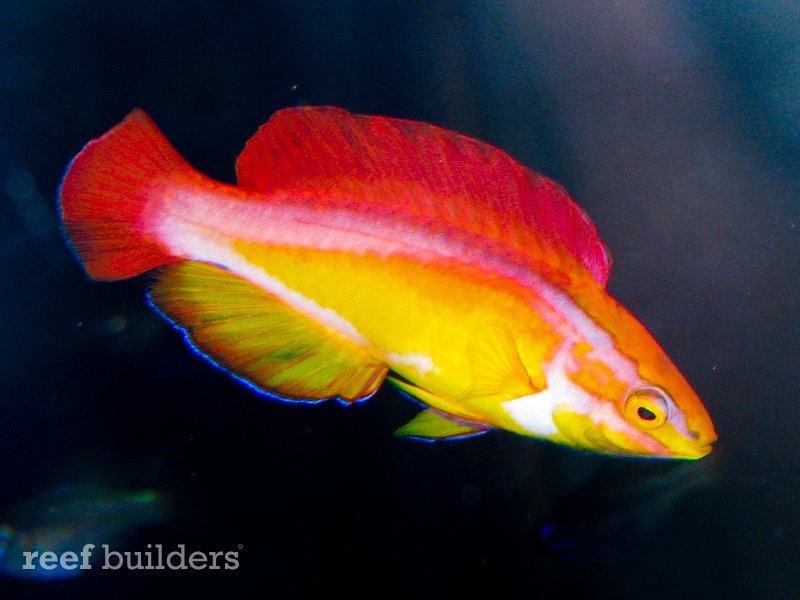
It’s no secret that male reef fish usually have much brighter colors and in some cases gaudy coloration compared to their female counterparts. This feature of sexual dichromatism is particularly pronounced in wrasses, anthias and to lesser degree in the gobies, dragonets and pygmy angelfish. The most widely believed explanation was based mostly on sexual selection: brighter colors should make it easier to find a mate. However new research by Grether and Anderson published in the latest issue of  Proceedings of the Royal Society B: Biological Sciences invokes competition between males of different species as another likely influence. The authors of the study worked with damselflies of closely related species and their findings indicated that where species overlap, the coloration of sexually active males was more differentiated between species than in areas where the species do not co-occur. The purpose behind this ecological observation is to prevent fighting and competition between males of species who have no need to fight since they are not competing for the same mates. It is plausible to conclude that similar mechanisms are at play in males of reef fish species, as the famed naturalist Konrad Lorenz first did as far back as 1962. For more information on this story visit the more focused writeup on PhysOrg. Pictured above is a displaying male flame wrasse, Cirrhilabrus jordani.


Related Posts

This thing has 17 Comments

  1. Jeremy Maneyapanda
    Posted November 2, 2009 at 6:52 am | Permalink

    Kinda takes a dump on a lot of hybridization theories and claims, too.

  2. Posted November 2, 2009 at 8:33 am | Permalink

    Jeremy you misread. This paper was more focused on competition between males than sexual selection between both sexes. it actually SUPPORTS the mechanisms of hybridization between species: if closely related species do not co-occur normally and a female wanders into the range of the other species, the male’s coloration will not be as pronounced and the female will be more likely to mate with the male of another species.

  3. Jeremy Maneyapanda
    Posted November 2, 2009 at 3:37 pm | Permalink

    ?? Jake Im not reading it that way. “The authors of the study worked with damselflies of closely related species and their findings indicated that where species overlap, the coloration of sexually active males was more differentiated between species than in areas where the species do not co-occur. The purpose behind this ecological observation is to prevent fighting and competition between males of species who have no need to fight since they are not competing for the same mates”. I read this as, the males are colring differently so they dont unnecessarily compete for non intended mates. If hybridization is common and acceptable, why wouldnt the males “choose” to have colors similar to the “intended” species? I still see it as comabtting hybridization, not supporting it.

  4. Posted November 2, 2009 at 4:01 pm | Permalink

    the study was primarily aimed at intraspecific aggression/competition between males of separate species.

  5. Jeremy Maneyapanda
    Posted November 2, 2009 at 5:09 pm | Permalink

    OK, let me dumb it down for you….:) Why would two males NOT want to compete for females? If they dont have the desire/interest/evolutionary drive to procreate with them. If they are close enough to confuse the other male as competition, then it would be considered a breeding threat. The differentiation, in and of itself, leans towards these species driving to NOT hybridize, as any conspecific aggression is being “targeted” towards conspecifics, not congenerics.

  6. Posted November 2, 2009 at 5:23 pm | Permalink

    I guess I am interpreting the research more where species are overlaping less, ie where most of our hybrids come from, rather than where they typically co-occur in large numbers. Most of our ornamental aquarium hybrids originate from the edge of one of the species ranges, not in their population centers.

  7. Jeremy Maneyapanda
    Posted November 2, 2009 at 5:59 pm | Permalink

    Jake, I dont understand how this would make a difference. If these fish are differntiating their coloration to dissuade conspecific aggression, how does this not translate to decreased sexual selection? How would two different appearing breeding males (different enough to decrease competitive aggression)be able to attract the same females? And not attract the attention of the “normally” colored males. Regardless of densities? School me…..

  8. Tim Morrissey
    Posted November 3, 2009 at 12:07 am | Permalink

    So if they discriminate more between males where the species overlap, and when they discriminate they don’t fight the males of the other species. That would allow that male to reside within its territory. This would potentially lead to an increase in hybridization because the male of one species would have to the potential to be around more females of another species.

    Also if the males don’t discriminate between males where there is only one species, the males would just defend against all males.

    This supports hybridization because if they prefer to defend against males of their own species it gives males of another species a chance to mate with a female of the different species.

  9. Jeremy Maneyapanda
    Posted November 3, 2009 at 2:11 am | Permalink

    Tim, Im not sure Im following. I think that there is abit of of an improper disconnect between conspecific competition between males, and selectual slecetion of females. The same thing that would draw a males to compete with another male is what draws the females to courtship. Are yuo suggesting that a differentiated male can still court and be selected by a female, but not be selected as a competitor by another male?

  10. Jeremy Maneyapanda
    Posted November 3, 2009 at 8:31 am | Permalink

    Jake!! Why did you edit out your comments?! I haven’t laughed like that in a while.

  11. Tim Morrissey
    Posted November 3, 2009 at 10:16 am | Permalink

    That is what I was suggesting Jeremy. Just suggesting…

  12. Jeremy Maneyapanda
    Posted November 3, 2009 at 12:06 pm | Permalink

    Hmmm. I cant really buy it would work that way. If it is, these fish are cognitively FAR more intelligent than we give them credit for. A differentiated drabber male would have to KNOW hes tricking a supermale, and “sneak” in mating. From my understanding of haremic breeders, this wouldnt work, in fish, mammals, or otherwise. But thats just my understanding and opinion. At the very least, I still dont see how this would promote hybridization.

  13. Tim Morrissey
    Posted November 3, 2009 at 1:09 pm | Permalink

    Species A has one color. Species B has another color. Species A males only defends against species A where both species A and B are present due to the difference in color. This allows species B to be in species A’s territory. This increases chances of hybridization.

    Where species A is the only species, species A males defend against all males.

  14. Jeremy Maneyapanda
    Posted November 3, 2009 at 5:45 pm | Permalink

    Yeah, I dont and cant buy it. If Species A and B are different in color, to the point where they do not see each other as sexual competition, then how do they attract, court, and reproduce with the same females? The ENTIRE purpose of sexual competition is to drive out competing breeders. If a duller drabber male can approach, court, and breed with the females, and not have ANY fo the negative effects of being colorful, then how would this trait persist? There is NO benefit to being flambuoyant. All reef animals would be grey and brown. This isnt possible.

  15. Tim Morrissey
    Posted November 3, 2009 at 6:44 pm | Permalink

    Because if fish are meeting in group spawns or release eggs and sperm in the water column cross fertilization can occur. And even in fish that do maintain a nest, it could be possible. I remember hearing that ORA had hybrid fish occur from systems that don’t even have hybrid pairs! In the diluted ocean this would probably be much less likely or may never happen, but I don’t know.

  16. Jeremy Maneyapanda
    Posted November 3, 2009 at 8:08 pm | Permalink

    Tim we’ll have to agree to disagree. I dont think were quite on the same page. In general, I do not doubt hybridization. However, I do feel it happenms FAR less than suggested. In an evolutionary sense, I dont see how two species could/would spend tens, if not huindreds, of millions of years speciating simply to hybridize out of error or chance. In this case, we are talking about dramatically dimorphic species between the sexes, and even between males. Not a uniform colored male/female (IE- tangs). Take a look at the photo for this entry- a gorgeous terminal male Jordan Wrasse. The non breeding males DOI NOT show this color, and females certainly dont. So, why does the male show it? To attrcat and maintian females within his harem. And females gravitate to it, as it is an evolutionary device to show fitness. Now, if we suggest that males without such colorations will not need to compete to breed, and will successfullyprocreate without such a trait, then the ONLY advantage to such coloration is lost. There are HUGE disadvantages- namely attention to predators. In the type of social structiure which would contain dimorphioc individuals (harem, etc), broadcast spawning may well occur, but with the group. A swarm of convict tangs broadcast spawning may hybrid without competition between males, but they are not maintained in harems.

  17. Tim Morrissey
    Posted November 3, 2009 at 11:20 pm | Permalink

    I agree with what you said. That makes sense. You are talking about males of the same species like supermales and nonbreeding males. I was talking about two different males of different species, but I was just taking a stab in the dark.

Post a Comment

Your email is never published nor shared. Required fields are marked *

*
*